
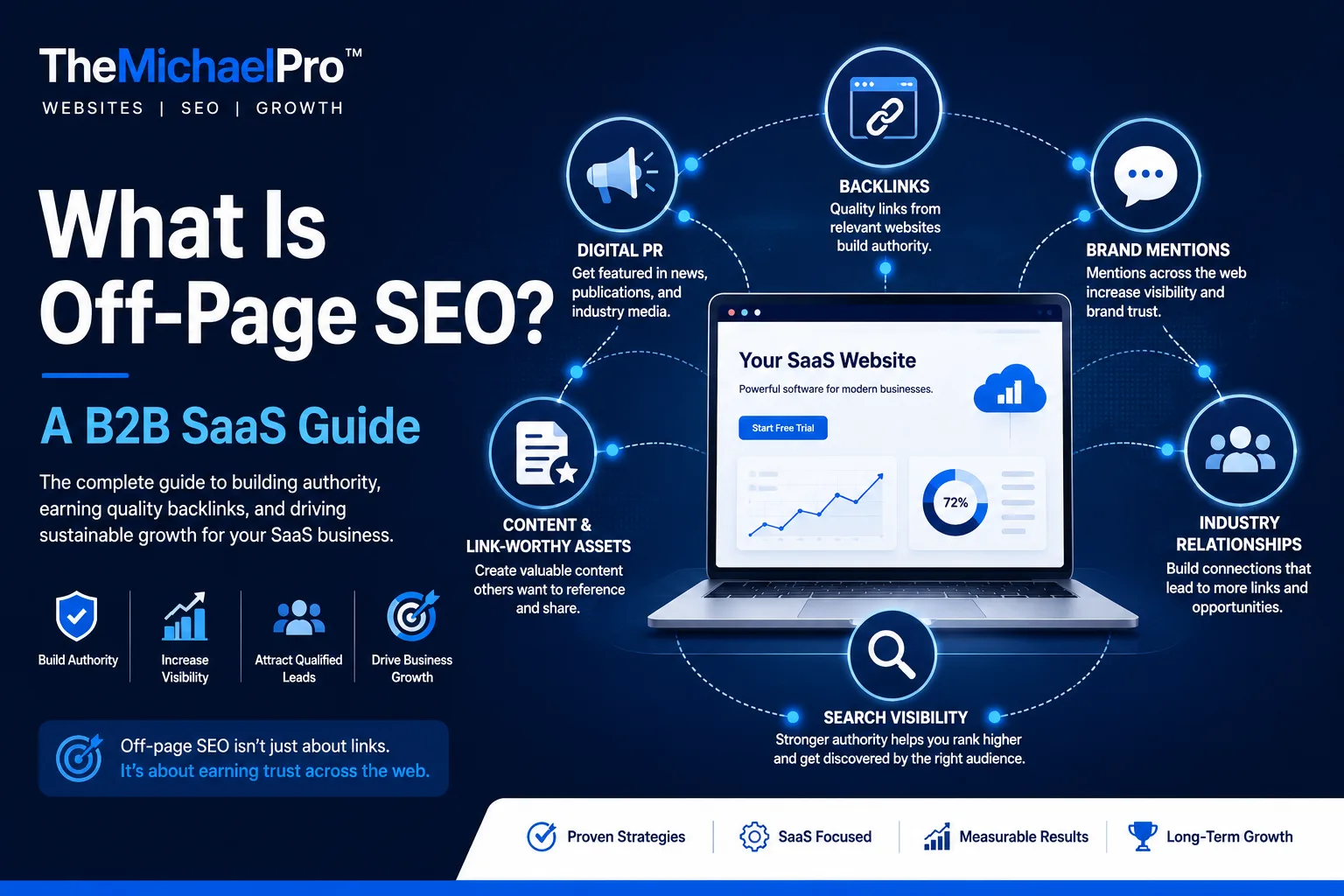
For B2B SaaS companies, publishing great content is only part of the SEO equation. Your ideal customers still need to discover your brand, other websites need reasons to mention and reference you, and search engines need signals that your business is trusted beyond its own website.
That is where off-page SEO comes in.
Off-page SEO helps SaaS companies expand their visibility beyond their own websites, attract relevant referral traffic, build authority and trust, and strengthen the signals that can support long-term organic rankings.
What Is Off-Page SEO?
Off-page SEO is everything you do outside your website to increase your brand's visibility, authority, credibility, and trust across the web.
Backlinks are an important part of this, but off-page SEO goes beyond link building. It can include digital PR, brand mentions, journalist outreach, guest contributions, partnerships, relevant directory placements, and community participation.
These activities help put your SaaS brand in front of the right audiences.
For B2B SaaS companies, the goal isn't simply to collect as many backlinks as possible. Quality matters more than quantity.
A strong off-page SEO strategy focuses on earning relevant mentions and links from websites that have a genuine reason to reference your company or content.
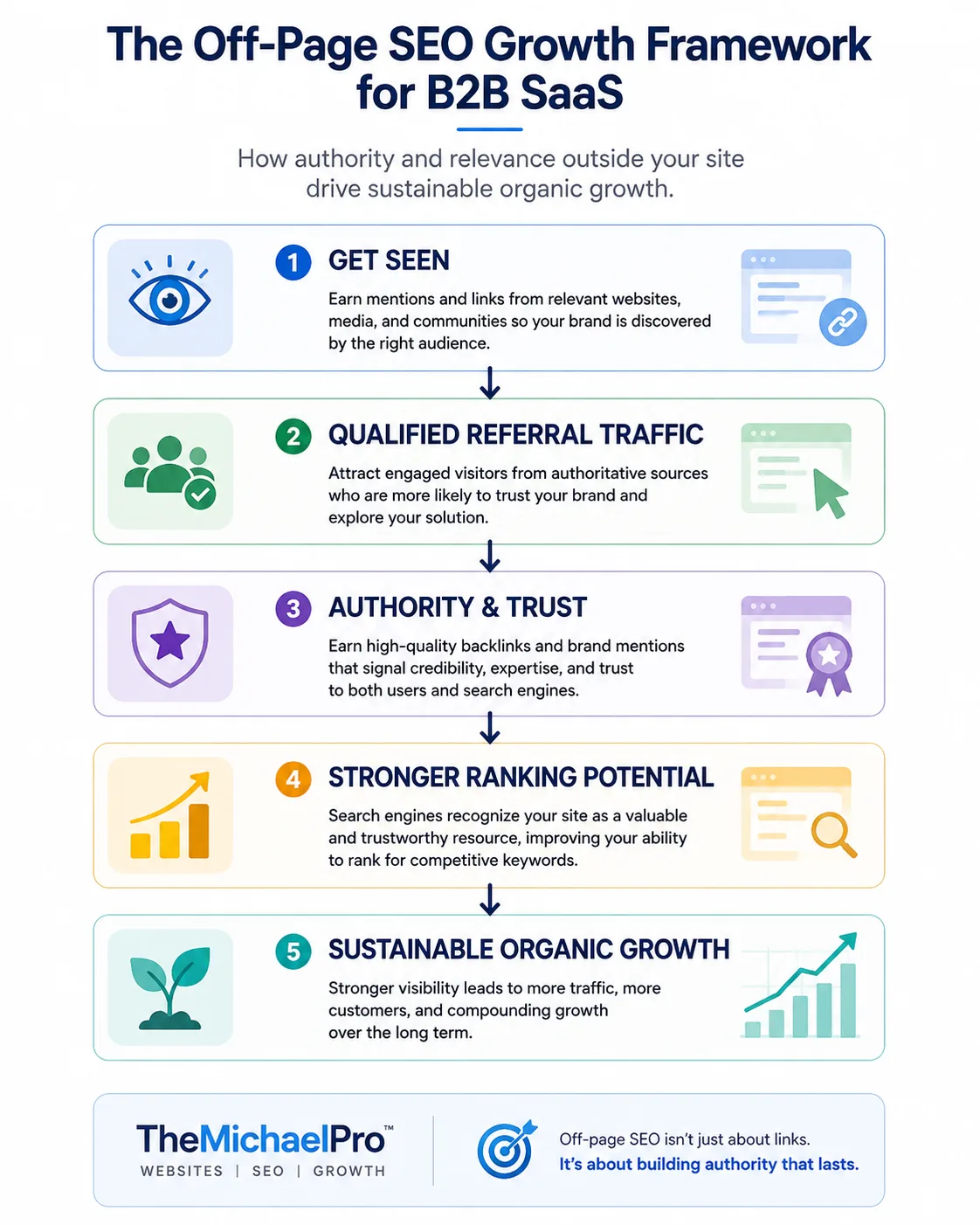
These external signals can create value at different stages. They can bring visibility and qualified referral traffic in the short term, build authority and trust over time, and support sustainable organic rankings and growth in the long term.
Why Off-Page SEO Matters for B2B SaaS
B2B SaaS companies often compete for the same valuable keywords and audiences. Publishing useful content is important, but good content still needs to be discovered.
Off-page SEO helps that content reach new audiences, earn references from other websites, and build trust beyond your own site.
The value of off-page SEO can be understood across three stages:
1. Immediate: Visibility and Qualified Referral Traffic
A relevant mention, guest contribution, digital PR placement, or backlink can put your SaaS brand in front of people who already care about the problem you solve.
This can generate brand exposure and qualified referral traffic even before your Google rankings improve.
Relevant editorial placements can also provide both referral traffic and authority rather than functioning only as links.
2. Mid-Term: Authority, Credibility, and Trust
As your SaaS company earns relevant backlinks, mentions, citations, and placements, its presence across the web becomes stronger.
Potential customers may also see your company referenced by sources they already trust. This can strengthen your credibility.
Relevant external links and mentions can also provide search engines with signals about your site's authority and relationship to a topic.
3. Long-Term: Rankings and Sustainable Organic Growth
Over time, stronger authority can work alongside quality content and a technically sound website.
Together, these factors can improve your ability to compete for valuable search terms.
Better rankings can then generate recurring organic traffic. This creates more opportunities for product discovery, leads, and customers without depending entirely on paid acquisition.
In simple terms:
Get Seen → Earn Relevant Traffic → Build Authority & Trust → Strengthen Rankings → Compound Organic Growth
On-Page SEO vs. Off-Page SEO
On-page and off-page SEO work toward the same goal, but they focus on different parts of your search presence.
On-page SEO focuses on what happens on your website. This includes content quality, search intent, page structure, internal linking, titles, and headings. These elements help search engines and users understand your pages.
Google recommends contextual internal links with descriptive anchor text to help users and Google discover and understand related pages.
Off-page SEO focuses on building visibility, authority, and trust outside your website. This can involve relevant backlinks, brand mentions, digital PR, partnerships, expert contributions, and other external opportunities.
For B2B SaaS companies, on-page and off-page SEO should work together. Backlinks cannot fix weak, irrelevant, or poorly structured content.
First, create a page worth finding. Then, give other websites a reason to reference it.
Before actively promoting a page, ask:
- Does this content genuinely satisfy the search intent?
- Is it useful enough that another website would feel comfortable recommending it?
- Does it provide something worth referencing?
- Is the page properly connected to other relevant content through internal links?
- Can the content be improved with original insights, data, examples, frameworks, or practical resources?
A strong off-page SEO strategy should therefore check whether a page is actually ready to earn links.
If it isn't, improve the content or create a stronger linkable asset before starting outreach.
What Makes B2B SaaS Content Worth Linking To?
Getting backlinks becomes easier when another website has a genuine reason to reference your content.
Think about it from the publisher's perspective. They don't link to your SaaS company because you need backlinks.
They link because your content helps them explain an idea, support a claim, provide evidence, recommend a useful resource, or better serve their audience.
This is why some types of content create stronger link opportunities than others.
Original Research and Data
Original surveys, industry studies, benchmarks, experiments, and proprietary data give writers something they cannot easily find elsewhere.
When a writer needs evidence to support a point, your research can become the source they cite.
Original studies and unique data can be strong linkable assets because they give publishers useful information to reference.
Statistics and Reliable Reference Content
Writers often need statistics and credible sources to support their arguments.
A well-researched statistics page can organize useful, current data around a specific SaaS topic. It can then become a reference for journalists, marketers, bloggers, and industry publishers.
The key is not simply collecting numbers.
Make your sources transparent, keep the information current, and help readers understand what the data means.
Practical Tools, Templates, and Checklists
Useful resources solve problems.
A SaaS ROI calculator, SEO checklist, outreach template, benchmarking tool, or downloadable framework gives another website something practical to recommend.
Tools, calculators, studies, and other useful resources can work as linkable assets because they give publishers something valuable to reference or recommend.
Unique Frameworks and Expert Insights
You don't always need a huge dataset to create something worth citing.
A useful framework, expert perspective, methodology, or original explanation can give writers a new way to understand or explain a subject.
For example, instead of looking at off-page SEO only as backlink acquisition, TheMichaelPro evaluates its impact across three stages:
Visibility & Qualified Referral Traffic → Authority & Trust → Rankings & Sustainable Organic Growth
The framework should provide a genuinely useful idea that another writer can reference. It should not simply give a new name to information that already exists.
Comprehensive Guides
A strong guide can earn links when it becomes a useful reference for a topic.
It should answer important questions, provide practical examples, explain difficult concepts clearly, and offer something beyond what already ranks.
Simply rewriting competing pages gives publishers little reason to choose your article as their source.
Original experience, research, frameworks, useful resources, and unique information give them stronger reasons to reference it.
The Simple Test
Before creating content specifically to earn links, ask:
"Why would another website want to show this to its audience?"
This aligns with Google's guidance on earning links naturally, which emphasizes creating unique, compelling content that people genuinely want to reference.
If there is no convincing answer, earning quality backlinks to the content will probably require much more effort.
Strong linkable content creates a clear exchange of value:
You give the publisher something useful to reference. The publisher gives its audience a better resource. You earn the opportunity for a relevant backlink.
What Makes a High-Quality Backlink?
Not every backlink carries the same value.
A dofollow link from a high-DR website is not automatically a good backlink. A link from a smaller website is not automatically a bad one either.
For B2B SaaS, don't judge backlink quality using one metric alone.
Look at several factors together, including relevance, website quality, editorial reason, audience value, authority, traffic, placement, and link attributes.
1. Relevance
Start by asking whether the linking website and page are relevant to your SaaS company, industry, audience, or topic.
A backlink makes more sense when there is a natural relationship between the referring page and the page it references.
Ahrefs identifies relevance as one of the key factors commonly used when evaluating backlink quality.
2. Is It a Genuine Website?
Look beyond Domain Rating.
Check whether the website publishes useful content, has a clear purpose, receives real organic traffic, and appears to serve an actual audience.
A high DR alone does not prove that a website is trustworthy or valuable.
Ahrefs recommends not using Domain Rating as a standalone metric, because DR measures backlink strength rather than the overall quality or legitimacy of a website.
3. Is There an Editorial Reason for the Link?
Ask one simple question:
Why would this page naturally need to reference ours?
Your content might provide data, support a claim, explain a concept, offer a checklist, give an example, or provide a useful resource.
The stronger and more natural the reason, the more attractive the opportunity becomes.
4. Does the Link Provide Audience Value?
A backlink should make sense for the people reading the referring page.
If someone clicks it, does the destination help them learn more or solve a related problem?
This is why relevant backlinks can provide value beyond SEO. The right placement can expose your SaaS company to potential customers and generate qualified referral traffic.
5. Authority and Organic Traffic
Metrics such as DR, UR, referring domains, and estimated organic traffic can help you evaluate an opportunity.
But these metrics should provide context, not make the decision for you.
For example, a smaller industry website with genuine traffic and a highly relevant audience may be more valuable than a high-DR website with little relevance to your business.
6. Placement and Context
A contextual link inside useful editorial content is generally more desirable than a random link in a footer, sidebar, author bio, or unrelated page.
The surrounding words also help explain why the destination is relevant.
7. Dofollow vs. Nofollow
Followed links can be valuable for search authority because they can pass link equity. But link attributes should not be your first quality test.
A relevant nofollow mention from a respected publication can still provide visibility, referral traffic, credibility, and brand value.
Google provides the nofollow, sponsored, and ugc attributes to help identify the nature of certain links.
Google recommends using sponsored for paid placements, while ugc is intended for links in user-generated content.
B2B SaaS Off-Page SEO Strategies That Actually Matter
There is no single off-page SEO tactic that works for every SaaS company.
The right strategy depends on your market, existing authority, content, competitors, and where your target audience spends time.
The goal is not to use every link-building tactic available. Instead, focus on opportunities where your SaaS brand has a genuine reason to be mentioned, cited, or recommended.
Competitor Backlink Analysis
Competitor backlink analysis can reveal link opportunities that already exist in your market.
Instead of simply copying competitor backlinks, study:
- Which competitor pages attract links?
- Which websites link to them?
- Why did those websites choose to link?
- Is the link editorial and relevant?
- Can you realistically provide something better or more useful?
- Are there similar websites that may have the same reason to link?
This turns competitor research into a roadmap for finding proven opportunities instead of blindly building prospect lists.
Linkable Assets
A strong linkable asset strategy focuses on creating content and resources that publishers have a genuine reason to reference.
For B2B SaaS, linkable assets can include:
- Original research and surveys
- Industry statistics
- Templates
- Checklists
- Calculators and free tools
- Benchmark reports
- Original frameworks
- Data studies
A strong asset gives you a stronger reason to contact websites that already discuss the subject.
Digital PR
Digital PR uses newsworthy stories, research, data, expert commentary, and other useful assets to earn coverage from journalists and industry publications.
For SaaS companies, digital PR can take many forms.
You might publish original research, analyze market trends, share proprietary data, or provide expert commentary on important industry developments.
Strong campaigns connect the story to something your company can credibly discuss. They also give journalists something their readers will care about.
Ahrefs' guide to digital PR explains how newsworthy content, stories, and data can be promoted to journalists to build awareness, authority, and links.
Digital PR can therefore generate brand exposure, referral traffic, authority, and backlinks rather than treating the link as the only outcome.
Journalist and Expert Outreach
Founders and subject-matter experts can become valuable sources for journalists and industry publishers.
When a journalist needs expert commentary on a topic your company understands, provide a useful and specific answer.
This can lead to a brand mention, citation, and sometimes a backlink.
The goal is to become a reliable source—not to force your website into every journalist request.
Resource Page Link Building
Resource page link building focuses on earning relevant placements on pages that collect useful industry resources, guides, tools, templates, or educational materials.
If your SaaS company has something genuinely useful that fits the page, suggest it to the publisher.
The value is simple: you help them improve their resource page, and they can introduce your content to a relevant audience.
Broken Link Building
Websites sometimes link to pages that eventually disappear.
Broken link building involves finding these dead resources, understanding why websites linked to them, and creating or identifying a suitable replacement.
You can then contact the publishers and suggest the replacement.
The important part is not simply finding a broken URL. Your replacement should satisfy the same reason the publisher originally gave the link.
Ahrefs recommends understanding why publishers linked to the dead page before creating a replacement resource.
Guest and Expert Contributions
Contributing useful content or expertise to relevant industry publications can introduce your company to established audiences.
For B2B SaaS, this works best when the publication reaches your target audience.
Your contribution should demonstrate genuine expertise and provide useful information, rather than exist only to insert a backlink.
Avoid large-scale guest posting designed primarily to manipulate rankings.
Google's spam policies classify certain links in paid articles, guest posts, and other placements intended to manipulate search rankings as link spam.
SaaS Lists, Comparisons, and Relevant Directories
Potential customers often discover software through comparison articles, industry lists, marketplaces, and directories.
Relevant placements can increase brand discovery and referral traffic. They may also create useful citations or backlinks.
Prioritize platforms your target customers might genuinely use.
The goal is not to get listed on hundreds of unrelated directories just to increase your backlink count.
Partnerships and Integrations
SaaS companies naturally build relationships with technology partners, integration partners, agencies, customers, and other businesses in their ecosystem.
These relationships can create natural link opportunities.
They may lead to:
- Integration pages
- Partner directories
- Case studies
- Joint research
- Webinars
- Co-marketing content
The relationship should exist because it makes business sense—not simply as an excuse to exchange links.
Brand Mentions and Communities
Off-page SEO does not stop at backlinks.
Your audience does not discover SaaS companies through Google alone.
Communities, podcasts, newsletters, industry discussions, and social platforms can introduce your company to relevant audiences through other channels.
As your brand becomes more visible, some websites may mention your company without linking to it.
These relevant unlinked mentions can become natural backlink opportunities when adding a link would genuinely help the reader.
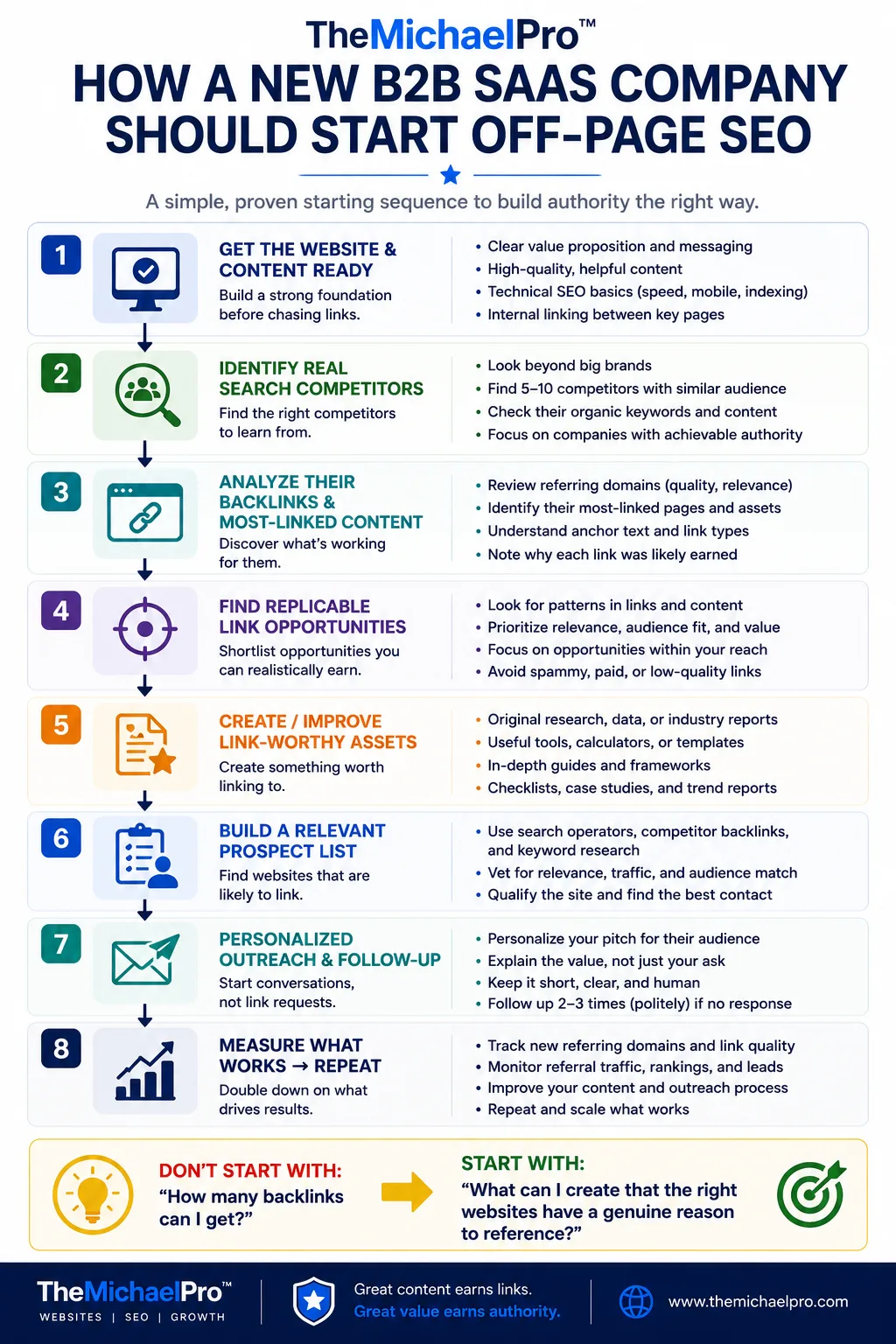
How Should a New B2B SaaS Company Start Off-Page SEO?
A new SaaS company does not need to chase hundreds of backlinks immediately.
When your website has little authority, start with opportunities you can realistically win.
Study what already earns links in your market. Then make sure you have content or resources worth promoting before you begin outreach.
Step 1: Build a Strong Foundation
Before outreach, make sure the pages you plan to promote are worth sending people to.
Review:
- Content quality and search intent
- Page structure and readability
- Internal linking
- Technical SEO basics
- Whether the content provides anything genuinely useful or distinctive
If the content is weak, improve it before investing heavily in link building.
Step 2: Find Achievable Competitors
You do not always need to start with the biggest companies in your industry.
Smaller competitors with established but achievable backlink profiles can reveal strategies that may be easier for a newer SaaS company to replicate.
Look for competitors that:
- Target a similar audience
- Publish content around similar topics
- Earn genuine editorial backlinks
- Use link-building strategies you could realistically execute
Step 3: Find Their Most-Linked Content
Don't look only at how many backlinks a competitor has.
Identify the pages that actually earn those links.
You may find that backlinks concentrate around:
- Statistics pages
- Original research
- Free tools
- Templates
- Checklists
- Comprehensive guides
- Industry reports
This shows you what publishers in your market already consider worth referencing.
Step 4: Understand Why Each Link Was Given
This is one of the most important steps.
Don't stop after finding a backlink.
Open the referring page and ask:
Why did this website choose to link to the competitor?
Maybe the competitor provided a statistic, supporting evidence, useful template, definition, expert opinion, tool, or deeper explanation.
Once you understand the reason, you can judge whether the opportunity is realistic for your company.
Step 5: Create Something Better or Different
Do not simply copy the competitor's content.
Use your research to understand what publishers value. Then create something that provides more or different value.
That could mean:
- Fresher data
- Better research
- More practical examples
- An interactive tool
- A downloadable template
- A clearer framework
- Better visualization
- A more specialized SaaS perspective
Your goal is simple: give publishers a strong reason to reference your resource.
Step 6: Find Lookalike Prospects
Once you understand why one website linked, find other websites that could have the same reason to link.
For example, imagine a SaaS marketing blog cites a competitor's industry statistics.
Other SaaS marketing, SEO, growth, and content websites covering the same topic may need those statistics too.
This can turn one discovered backlink into a much larger prospect opportunity.
Step 7: Find the Right Person
Avoid sending the same message to every email address you find.
Depending on the opportunity, the right contact could be:
- The article author
- Content manager
- SEO manager
- Editor
- Marketing manager
- Journalist
- Website owner
Reach the person who can actually evaluate your suggestion.
Step 8: Reach Out, Follow Up, and Track Results
Your outreach should answer:
"How does this help me or my audience?"
Instead of:
"I created an article. Please link to it."
Explain why your resource is relevant to something they already published.
Show how it could make their content more useful, complete, current, or credible.
No response does not automatically mean the opportunity is dead.
A reasonable follow-up can bring your message back to someone's attention without turning your outreach into spam.
Track:
- Prospects contacted
- Replies
- Links earned
- Brand mentions
- Referral traffic
- Link quality
- Which outreach angles work
Over time, this data shows which strategies deserve more investment.
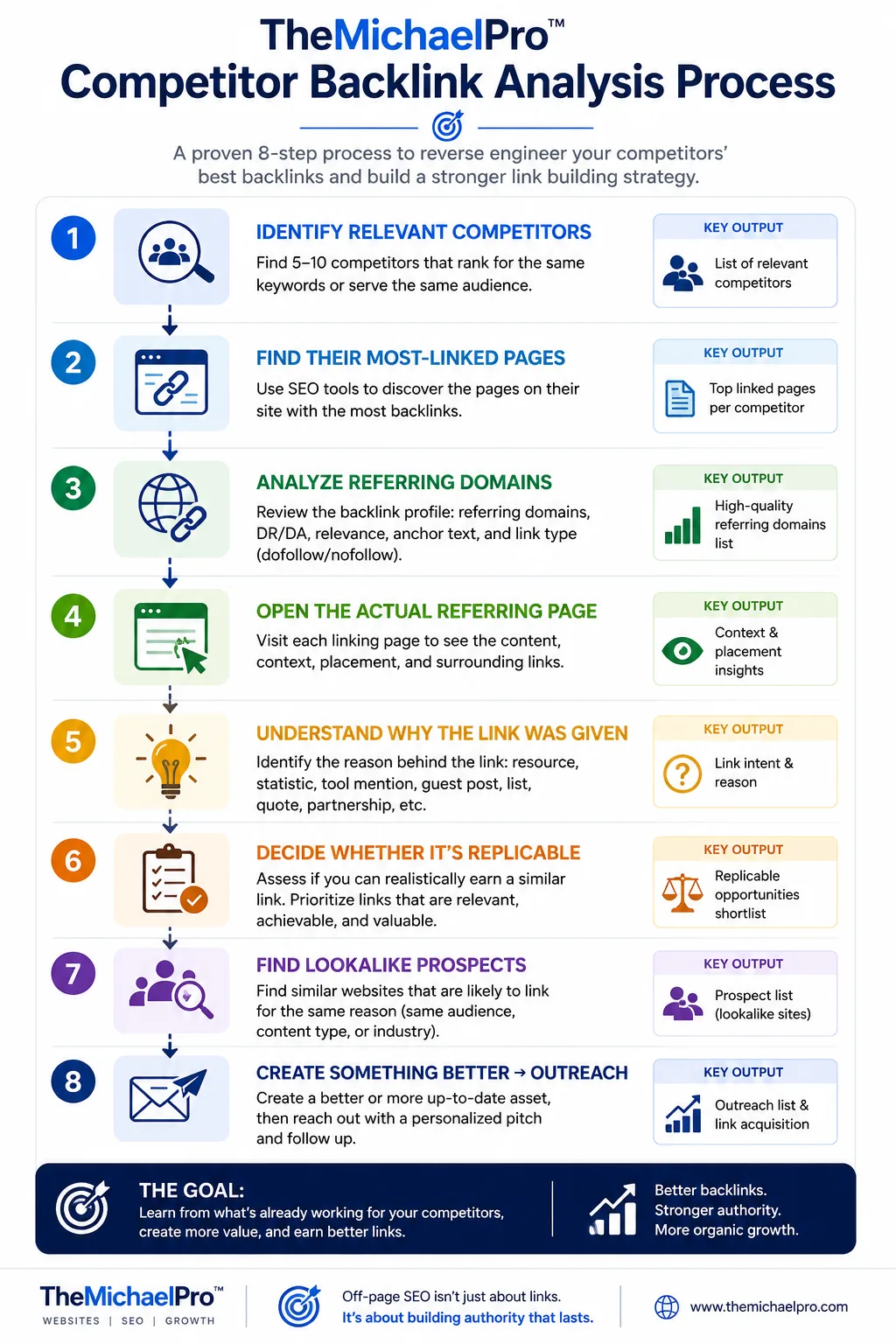
How to Analyze Competitor Backlinks
Competitor backlink analysis goes beyond finding websites that link to your competitors.
The real goal is simple: understand which links are valuable, why competitors earned them, and whether you can realistically earn similar links.
1. Choose Relevant and Achievable Competitors
Start with companies competing for similar customers, topics, or search visibility.
Large industry leaders can provide useful ideas. But smaller competitors may reveal opportunities that are easier for a growing SaaS company to replicate.
The goal is not to find the competitor with the highest DR.
Find competitors whose backlink strategies can teach you something useful.
2. Find Their Most-Linked Pages
Use a backlink analysis tool to identify competitor pages receiving links from multiple unique referring domains.
Pay particular attention to assets such as:
- Original research
- Statistics pages
- Free tools
- Templates
- Checklists
- Industry reports
- Comprehensive guides
- Unique data or frameworks
These pages reveal what publishers in your industry already consider worth referencing.
3. Evaluate the Referring Website
Don't assume every competitor backlink is worth replicating.
For each referring domain, consider:
- How relevant is the website to your industry or audience?
- Does it appear to be a genuine website serving real readers?
- Does it receive meaningful organic traffic?
- Is the referring page relevant to the linked content?
- Is the link editorially placed?
- Does the website appear spammy or built primarily for selling links?
Metrics such as DR and organic traffic can help.
But they should support your judgment, not replace it.
4. Open the Referring Page
This is where some of the most valuable analysis happens.
Open the page containing the backlink and study the surrounding paragraph.
Ask:
Why did the writer need this link?
They might be:
- Supporting a claim
- Citing a statistic
- Recommending a tool
- Providing further reading
- Referencing research
- Giving an example
- Linking to a useful template or checklist
- Crediting an expert or original source
The answer reveals the linking reason.
5. Decide Whether the Opportunity Is Replicable
Once you know why the competitor earned the backlink, ask whether your SaaS company could provide the same—or greater—value.
For example:
Competitor earned link because of outdated statistics
→ Create fresher and better-sourced statistics.
Competitor earned link because of a useful checklist
→ Create a more practical or specialized checklist.
Competitor was cited for original research
→ Conduct your own research rather than copying theirs.
Competitor provided a comprehensive explanation
→ Create a clearer, more current, or more specialized resource.
Not every competitor backlink should be copied.
Some links come from partnerships, existing relationships, owned websites, low-quality networks, or circumstances you cannot realistically reproduce.
6. Find Lookalike Opportunities
One valuable backlink can reveal an entire prospect category.
Imagine a SaaS marketing website links to a competitor's research because it needs supporting evidence.
Now look for other websites publishing content where the same type of evidence could be useful.
This changes your thinking from:
"How do I get this exact backlink?"
to:
"What type of website has the same reason to link?"
That second question can uncover many more opportunities.
7. Prioritize the Best Opportunities
Before outreach, prioritize prospects using a simple framework:
Relevance → Genuine Website → Editorial Reason → Audience Value → Authority & Traffic → Placement → Replicability
A relevant editorial opportunity from a genuine industry website can be more valuable than several easy links from unrelated high-DR domains.
Common B2B SaaS Off-Page SEO Mistakes
Off-page SEO can produce strong results, but poor execution can waste time and money. It can also create unnecessary search risk.
Here are some of the most common mistakes B2B SaaS companies should avoid.
1. Chasing Backlink Quantity
Having more backlinks does not automatically mean having a stronger backlink profile.
Hundreds of links from irrelevant, low-quality, or spammy websites may provide little meaningful value.
Focus on why the link exists and who it could benefit, not simply how many links you can acquire.
2. Judging Opportunities by DR Alone
Domain Rating can help you understand the relative backlink strength of a website. But it should not make the decision for you.
A high-DR website can still be irrelevant to your business.
Meanwhile, a smaller niche publication may have a highly relevant audience and a legitimate reason to reference your content.
Use authority metrics as one part of your evaluation—not the entire evaluation.
3. Chasing Dofollow Links Alone
Dofollow links can help pass link equity. But dofollow status alone does not make a backlink high quality.
A good opportunity should first make sense based on:
Relevance → Website Quality → Editorial Reason → Audience Value → Authority → Link Attribute
A relevant nofollow mention from a respected publication can still provide visibility, referral traffic, brand exposure, and credibility.
4. Building Links to Content That Is Not Ready
Outreach becomes much harder when the page you promote offers nothing better, different, or particularly useful.
Before building links, check whether the content:
- Satisfies its intended search intent
- Is accurate and current
- Is structured clearly
- Provides useful examples
- Offers original insights or resources
- Has appropriate internal links
- Gives another publisher a genuine reason to reference it
Sometimes the best SaaS link building decision is to improve the asset before starting outreach.
5. Copying Competitor Backlinks Without Understanding Them
Finding a competitor backlink does not automatically make it an opportunity for you.
The competitor may have earned that link because of:
- Original research
- A business partnership
- A useful statistic
- An existing relationship
- A guest contribution
- A free tool
- A unique resource
- A mention in a comparison article
First, understand why the link was given.
Then decide whether you can realistically replicate the strategy.
6. Sending Generic Mass Outreach
Sending the same pitch to hundreds of websites may seem faster. But generic outreach gives publishers little reason to care.
A good pitch should make the value clear to the publisher and their audience.
Strong outreach should show that you understand:
- Their website
- The specific content you're contacting them about
- Why your resource is relevant
- How adding it could benefit their audience
The goal is not simply to ask for something.
It is to present a relevant exchange of value.
7. Pitching Irrelevant Websites
A website having a high DR does not mean its audience is relevant to your SaaS company.
Prioritize websites connected to your industry, topic, customers, or the problem your product solves.
A relevant placement can build authority while also creating opportunities for qualified referral traffic.
8. Buying Links Without Considering the Risk
Paying for links specifically to manipulate search rankings can create unnecessary risk.
It may also violate Google's link spam policies when links are not appropriately qualified.
Large-scale link buying, private link networks, and websites created mainly to sell ranking influence should not form the foundation of a sustainable SaaS SEO strategy.
Instead, build a backlink profile where real websites have legitimate reasons to reference your company and content.
9. Ignoring Referral Traffic and Business Value
A backlink is not valuable only because a crawler discovers it.
Ask whether the placement can:
- Introduce your company to relevant people
- Generate qualified referral traffic
- Strengthen brand credibility
- Build industry relationships
- Support rankings
- Eventually contribute to leads or customers
Off-page SEO should support business growth—not simply make a backlink counter increase.
10. Expecting Immediate Ranking Results
Off-page SEO compounds over time.
A new placement may create visibility or referral traffic relatively quickly.
Authority development and ranking improvements can take longer.
Measure progress across multiple stages. Don't judge an entire campaign only by whether rankings increase immediately after earning a few backlinks.
The Mistake Behind Most Bad Link Building
Many off-page SEO mistakes start with the question:
"How can we get more backlinks?"
A better question comes first:
"Why would a credible website want to reference us?"
Start with the second question. Then build your backlink strategy around genuine value and a clear reason to link.
How to Measure B2B SaaS Off-Page SEO Results
Off-page SEO should not be measured by backlink count alone.
It creates value at different stages.
Visibility and referral traffic can appear first. Authority and trust build over time. Rankings and organic growth usually take longer.
For B2B SaaS companies, it helps to measure performance across three stages.
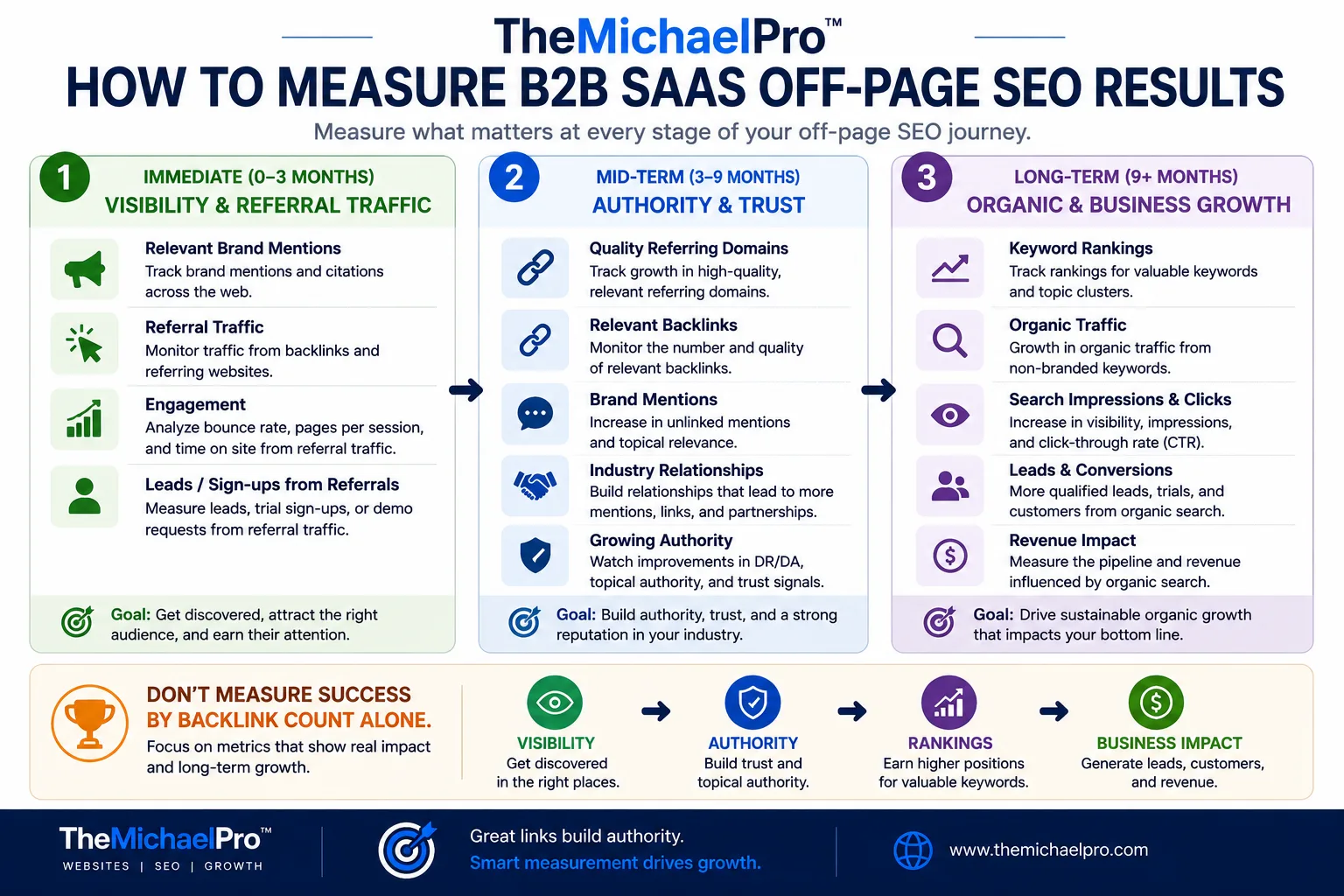
Visibility and qualified referral traffic
Authority and trust
Rankings, organic growth and business impact
1. Immediate: Visibility and Qualified Referral Traffic
A relevant placement can start creating value as soon as it goes live.
Track metrics such as:
- Referral traffic from earned placements
- New brand mentions
- Relevant publication features
- Traffic to promoted content
- Engagement from referred visitors
- Leads or sign-ups from referral sources
Don't ask only:
"Did we get a backlink?"
Also ask:
"Did this placement put our SaaS company in front of people who could actually care about what we offer?"
2. Mid-Term: Authority, Trust, and Backlink Profile Growth
As quality mentions and backlinks accumulate, check whether your website is building a stronger presence within its industry.
Track:
- New referring domains
- Quality and relevance of referring domains
- Dofollow and nofollow link distribution
- Links to important commercial and informational pages
- Growth in brand mentions
- Authority metrics such as DR or similar third-party metrics
- Relationships with relevant publishers and industry websites
Do not treat DR as a Google ranking score.
It is a third-party metric that can help you monitor backlink strength. Consider it alongside relevance, traffic, link quality, and business impact.
3. Long-Term: Rankings, Organic Traffic, and Business Growth
Over time, strong content, solid technical foundations, and off-page authority can improve your ability to compete in organic search.
Track:
- Keyword ranking improvements
- Growth in non-branded organic traffic
- Organic traffic to pages receiving links
- Search impressions and clicks
- Leads generated through organic search
- Demo requests or trials
- Organic conversions
- Revenue influenced by organic search
The purpose of off-page SEO is not to produce an impressive backlink spreadsheet.
The goal is to create greater visibility, stronger authority, better search performance, and more opportunities for business growth.
Measure Link Quality, Not Just Link Quantity
For every meaningful backlink, consider tracking:
- Referring website
- Referring page
- Target page
- Anchor text
- Dofollow or nofollow
- Website relevance
- Estimated organic traffic
- Reason the link was earned
- Referral traffic generated
- Leads or conversions, where measurable
This helps you see which strategies actually produce valuable results.
Don't Ask Only "How Many Backlinks Did We Get?"
Ask better questions:
Did we earn links from websites that matter?
Did those placements reach the right audience?
Is our authority within the topic becoming stronger?
Are rankings and organic visibility improving over time?
Is that growth contributing to leads and customers?
These questions provide a clearer picture of whether your off-page SEO strategy is actually working.
B2B SaaS Off-Page SEO Checklist
Use this checklist when planning or reviewing an off-page SEO campaign for a B2B SaaS website.
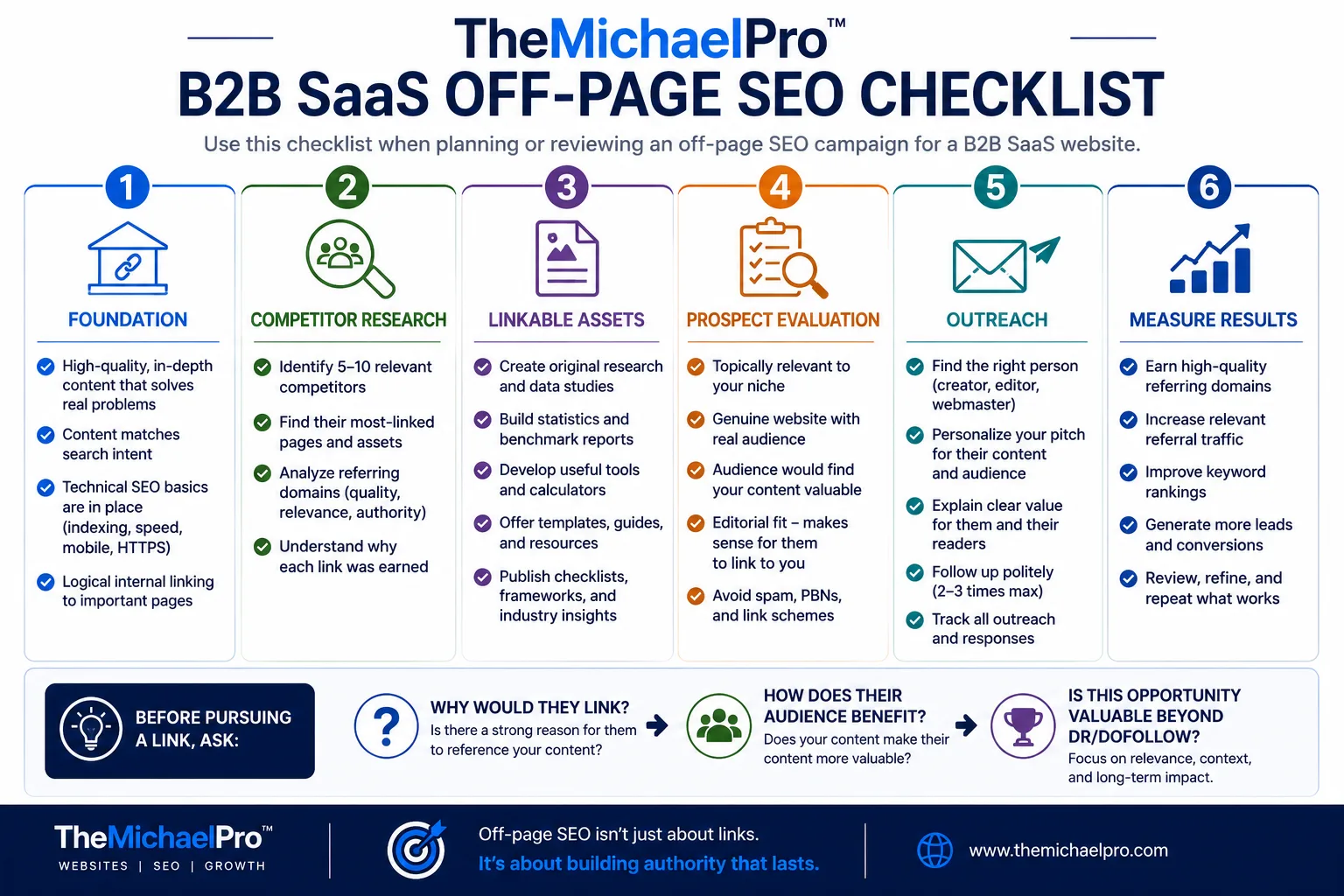
Foundation
- Confirm the website is technically crawlable and indexable
- Make sure important pages satisfy their search intent
- Review the quality and structure of existing content
- Fix weak internal links between relevant pages
- Identify pages that are strong enough to promote
- Identify content that needs improvement before link building
Competitor Research
- Identify relevant and realistic competitors
- Analyze their referring domains and backlinks
- Find competitor pages earning links from multiple relevant websites
- Separate genuine editorial links from spam or low-value links
- Open the actual referring pages
- Understand why each useful backlink was given
- Identify backlink strategies you can realistically replicate
- Find similar websites that could have the same reason to link
Linkable Content
- Determine whether you already have content worth referencing
- Identify gaps in competitors' linkable assets
- Consider original research or proprietary data
- Consider statistics and benchmark pages
- Create useful templates or checklists where appropriate
- Consider calculators, free tools, or interactive resources
- Add original frameworks, expert insights, or examples
- Make important assets easy to understand and reference
Prospect Evaluation
For every potential referring website, ask:
- Is the website relevant to our topic, industry, or audience?
- Does it appear to be a genuine website?
- Does it publish useful content for real readers?
- Does it receive meaningful organic traffic?
- Is there a natural editorial reason for it to reference us?
- Would the link provide value to its audience?
- Would the placement be contextually relevant?
- Would the opportunity still make sense if the link were nofollow?
Outreach
- Identify the right person to contact
- Understand the page you are pitching before reaching out
- Explain why your resource is relevant
- Focus the pitch on value to their audience
- Personalize important outreach
- Avoid generic mass link requests
- Track every prospect and outreach attempt
- Follow up reasonably when appropriate
Link Quality Review
Before considering a backlink valuable, evaluate:
Relevance → Genuine Website → Editorial Reason → Audience Value → Authority & Traffic → Placement & Context → Link Attribute
Do not approve a backlink simply because it has a high DR or is dofollow.
Measurement
- Track new quality referring domains
- Track relevant backlinks earned
- Monitor brand mentions
- Measure referral traffic
- Monitor important keyword rankings
- Track organic impressions and clicks
- Monitor organic traffic growth
- Track leads and conversions where possible
- Record which strategies produce the best opportunities
- Improve the strategy based on results
The Final Check
Before pursuing a backlink, ask three simple questions:
1. Why would this website want to link to us?
2. How would the link benefit its audience?
3. Would we still want this placement if DR and dofollow status were hidden from us?
If you cannot give convincing answers to the first two questions, the opportunity probably should not be a priority.
Frequently Asked Questions About B2B SaaS Off-Page SEO
Is Off-Page SEO the Same as Link Building?
No. Link building is an important part of off-page SEO, but off-page SEO is broader.
It includes activities outside your website that increase your brand's visibility, authority, credibility, and trust.
These can include backlinks, digital PR, brand mentions, journalist outreach, partnerships, expert contributions, relevant communities, and other third-party exposure.
How Long Does Off-Page SEO Take to Work?
There is no fixed timeline.
Results depend on your starting authority, competition, content quality, industry, and the quality of the opportunities you earn.
Some benefits can appear before rankings improve. For example, a relevant placement may generate brand visibility and referral traffic as soon as it goes live.
Authority and trust can grow as quality mentions and backlinks accumulate. Meaningful ranking and organic traffic improvements usually take more time and consistent work.
Think of the progression as:
Visibility & Referral Traffic → Authority & Trust → Rankings & Sustainable Organic Growth
How Many Backlinks Does a B2B SaaS Website Need?
There is no universal number.
The number you need depends on the keywords you want to compete for, the strength of competing pages, your existing authority, content quality, topical relevance, and backlink quality.
Instead of setting an arbitrary target such as "100 backlinks," study the pages already competing for your important searches.
Then look at what makes their backlink profiles strong.
What Makes a Backlink High Quality?
A strong backlink usually has several qualities working together:
- The referring website or page is relevant
- The website appears genuine and serves a real audience
- There is a legitimate editorial reason for the link
- The link provides value to readers
- The placement is contextually appropriate
- The referring website and page demonstrate reasonable quality
- The link was not created mainly to manipulate rankings
Metrics such as DR, organic traffic, and dofollow status can help you evaluate an opportunity.
But no single metric should determine backlink quality.
Are Nofollow Backlinks Worth Getting?
Yes, depending on the opportunity.
A nofollow backlink from a relevant and respected publication can still generate referral traffic, increase brand visibility, strengthen credibility, and introduce your SaaS company to the right audience.
Don't automatically reject a valuable placement simply because the link is nofollow.
Should B2B SaaS Companies Buy Backlinks?
Buying links specifically to manipulate search rankings can create unnecessary risk. It may also violate Google's spam policies when links are not appropriately qualified.
Instead of building your strategy around purchased ranking influence, create legitimate reasons for relevant websites to mention, cite, recommend, or reference your company.
Can a New SaaS Website Compete With High-Authority Websites?
Yes, but choosing the right opportunities matters.
A new website may struggle to compete immediately for highly competitive keywords dominated by established brands.
Start with more achievable topics. Build useful resources, earn relevant backlinks, strengthen topical authority, and expand into more competitive searches over time.
Competitor research can help you identify opportunities where the gap is realistically achievable.
What Types of Content Earn Backlinks for SaaS Companies?
Common linkable formats include:
- Original research
- Industry statistics
- Benchmark reports
- Free tools and calculators
- Templates
- Checklists
- Unique datasets
- Original frameworks
- Expert insights
- Comprehensive reference guides
The format itself does not guarantee backlinks.
Your content still needs to give publishers a genuine reason to reference it.
Should I Build Backlinks to My Homepage or Blog Content?
Both can earn links. The right target depends on why the link exists.
Brand mentions, partnerships, directories, and company references may naturally point to your homepage or commercial pages.
Research, statistics, tools, templates, checklists, and educational resources are often more natural targets for editorial backlinks.
Strong internal linking can then connect those informational resources with relevant commercial pages.
What's the Best Off-Page SEO Strategy for a New B2B SaaS Company?
There isn't one tactic that works best for every company.
A practical starting process is:
Study relevant competitors → Find what earns their best links → Understand why those links were given → Create something worth referencing → Find similar prospects → Reach the right people → Explain the value → Track what works.
The goal is not to copy competitors.
Instead, learn what publishers in your market already value and create stronger reasons for them to reference you.
Build Authority Beyond Your Website
B2B SaaS off-page SEO is not simply a race to collect as many backlinks as possible.
Strong off-page SEO starts with understanding where your audience spends time and what publishers in your industry find worth referencing.
Then ask:
What can your company contribute that genuinely deserves their attention?
Create content and resources worth linking to. Study why competitors earn their strongest links. Build relationships with relevant publishers. Then pursue opportunities that make sense for both your business and the publisher's audience.
Remember the progression:
Visibility & Qualified Referral Traffic → Authority & Trust → Rankings & Sustainable Organic Growth
And when evaluating a backlink opportunity, come back to one question:
Why would this website genuinely want to recommend this page to its audience?
If you can consistently answer that question, your off-page SEO strategy becomes more than link building.
It becomes a system for expanding your SaaS company's visibility, credibility, and authority across the web.
Need Help Building Authority for Your B2B SaaS?
TheMichaelPro helps B2B SaaS companies identify the content, backlink, and digital PR opportunities already working in their markets—and turn those insights into practical B2B SaaS off-page SEO strategies.
We analyze your competitive landscape, evaluate whether your content is ready to earn links, identify relevant opportunities, and help you build authority for sustainable organic growth.
Explore Our B2B SaaS Off-Page SEO Services
Or, if you're ready to discuss your goals:
.webp?token=eyJraWQiOiJzdG9yYWdlLXVybC1zaWduaW5nLWtleV9lYzc2Zjg3OS05NTk4LTRkZTAtOGZlZC1jN2MwNzQzZGE4NTQiLCJhbGciOiJIUzI1NiJ9.eyJ1cmwiOiJtZWRpYS8xNzg2OTkwMDcwNzUyLTF0b3A2OC1vbGFkaXB1cG8tbWljaGFlbC1mb3VuZGVyLXRoZW1pY2hhZWxwcm8gKDIpLndlYnAiLCJzY29wZSI6ImRvd25sb2FkIiwiaWF0IjoxNzg2OTkwMDcyLCJleHAiOjIxMDIzNTAwNzJ9.MGFBoO7hbT4HUqBAQVJR9jfv3v7vOng4T3ps_w9T2Ek)